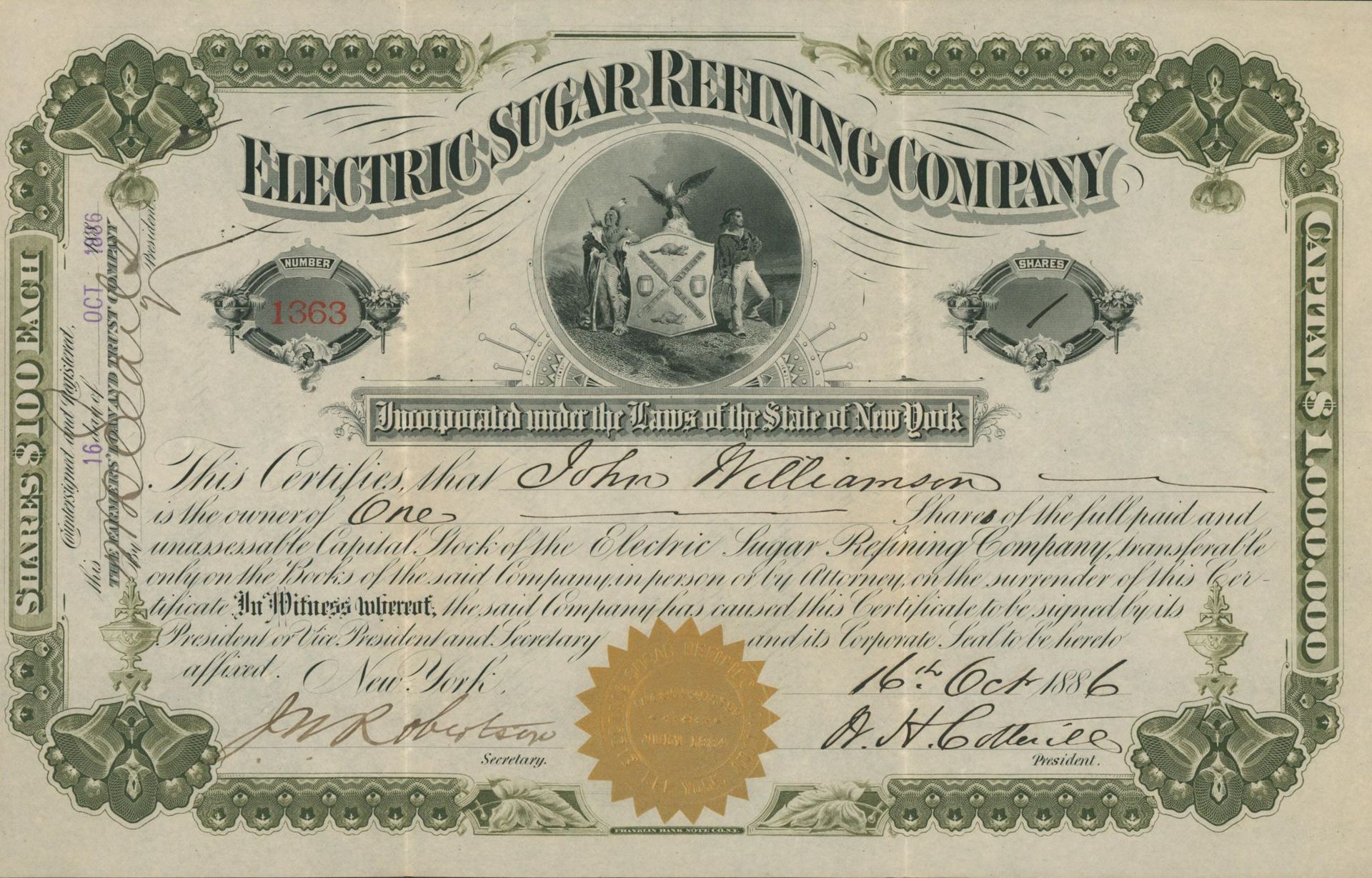

| Typ | Common |
|---|---|
| Nummer | 1363 |
| Stückzahl | 1 |
| Nennwert | 100 US-$ |
| Ausgabeort | New York, USA |
| Ausgabedatum | 16. Oktober 1886 |
| Druckerei | Franklin Bank Note Company in New Jersey |
| Sprache | Englisch |
| Erwerbsjahr | 2013 |
| Erhaltung | EF |
Beschreibung
Electric Sugar Refining Company set up in 1884 ranks high amongst the number of audacious and elaborate frauds committed in business. As the company name suggests the initiator Henry C. Friend claimed to have developed a process to turn raw into refined sugar using electricity - when electricity was all the rage. The company had a “factory” to “demonstrate” the process to investors. During the demonstrations the utmost secrecy was employed - hidden rooms with iron sheets on their walls and cloth over the machinery - as it was claimed that the process could not be patented or at least was not yet patented (this much was true) and therefore needed to be hidden. In reality the swindlers exchanged raw for refined sugar which they showed as the result of their process. The fraud was kept up for a remarkable time - in 1888 the self-professed professor Friend (or Freund as he occasionally claimed German origin) died and in early 1889 it all fell apart…Friend and friends had spent the investors' money on a luxurious life-style and there was little to be recovered. Criminal proceedings followed. Incidentally the bulk of the defrauded investors were British and obviously the scheme was more popular in the British press at the time…
Quite typical but decorative certificate for common stock. A large vignette with an interpretation of the New York seal (beaver, windmill and barrels plus a settler and an Indian). Unusual - golden - corporate seal.
Sources: 02 Jul 1884, 1 - The Brooklyn Union at Newspapers.com, The Great Electric Sugar Con | American Experience | Official Site | PBS all retrieved on 18.5..2022