Curious - Strange, Unusual or Erroneous
In collecting certificates of sugar companies for over 30 years and now putting my collection online I have come across things that are remarkable not only as pieces of corporate and industrial history. Often things did not go to plan – at least for some of the involved parties. The following highlights at least some of the peculiarities I have come across:
Where am I?
Dutch-Indies sugar companies were often named after the factory they owned. In the case of the Mayong Plantation Company the name is spelt differently on the certificate and the coupons. See for yourself:

The name "Mayong" on the share certificate issued in 1927 spelt "Maijong" on the attached coupons. Incidentally in a 1932 list of Javanese sugar factories the name is given as Majong...
Tell me where the wind blows...

In this wonderful vignette on the 1872 share of the Actien-Zucker-Fabrik-Dettum there is plenty of smoke coming from the factory chimneys and the steam engine of a freight train - so much that it must have been confusing: Most smoke is blowing to the right but the three chimneys to the left of the big chimney in the middle seem to be subject to the wind blowing in a different direction. But this can not have bothered the good farmers of Dettum as the same unchanged certificates were used for an 1882 capital increase. But this might also be explained by a certain tight-fistedness...
Do you speak Dutch?
Whilst certificates with information in more than one language are quite frequent I have in no other context than the Dutch-Indies come across certifcates in different languages for essentially the same thing - but here there is a material difference:

Effectively the English language certificate offers a bonus share for two shares subscribed and the Dutch language piece refering to exactly the same share issue offers four bonus share for four shares subscribed. Whether this was a mistake or the receipts were designed at different stages of the issuance process or there is another explanation I do not know.
To the bearer or not to the bearer?

Usually share certificates are either bearer or registered. Basically this means in the case of the former that the rights of ownership of the certificate can be exercised by whoever is in possession. For registered shares the owner is stated on the certificate itself and in the case of a change in ownership either a new certificate is issued and the old one destroyed or invalidated or the new owner is stated on the certificate usually on the back or inside. The below certificate is unusual in a number of ways but most unusual is the fact that it is a bearer share (1 Dutch: aan toonder) is in 1934 transferred to an "Anna-Maria Stiftung" in Chur (2) and in 1935 back to bearer (3).
Whilst this may seem counterintuitive I have come across other Dutch bearer pieces that provide for the entry of holders on the inside for an example see here.
In it for the long run…
Often coupons were attached with certificates that allowed the holder to receive the payments of for example dividends or interest. Frequently we find 20, 24 or 40 such coupons with shares and bonds. In the case of the below share certificate of the Suikeronderneming "Somo Bito" a Dutch-Indies sugar company a full 120 coupons came with the shares. This would have been enough for 120 years making the unrealistic assumption that every year a dividend would be paid. In the end 62 coupons were detached over the 80 years over which the certificate must have been valid. The rest is below:

They come in all sizes…
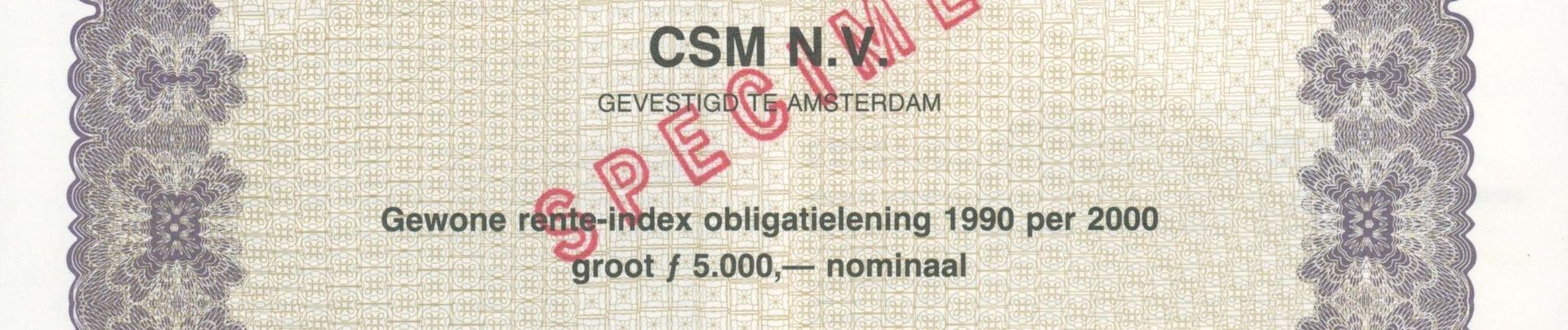
Companies often issued bonds to finance themselves. Given that almost all the bonds I have are printed securities (and a few are type written) and companies usually have larger financing requirements the typical issue sizes of bonds are from very large to large - relative to the requirements of a typical household. Even in the 18th century a securitized loan to planters in the Dutch colony of Essequibo was for 400,000 fl. Now here comes the opposite end. In 1990 CSM - a serial issuer of bonds - had securities printed for a bond where the intended outstanding was 5,000 fl. I have no idea why this was necessary or why it made sense - but here is the link to the bond. Detail below:
Taking doggie for a walk...
In this otherwise fairly typical vignette of an early German sugar factory we find - of course - the factory building, horse drawn carriages, workers and - unusually - a couple taking their dog for a walk. Here is a link to the share certificate.

A false Friend…
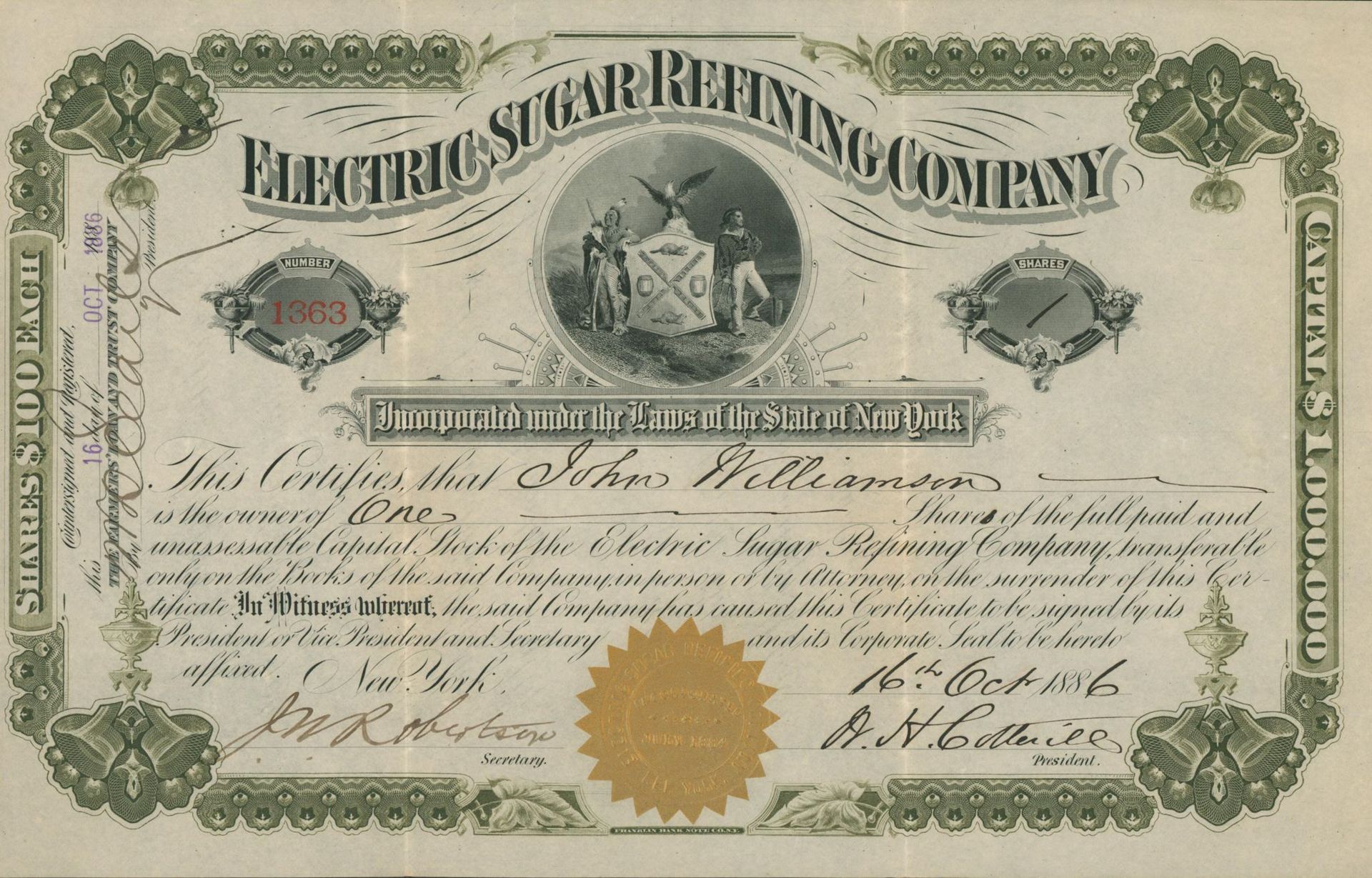
Electric Sugar Refining Company set up in 1884 ranks high amongst the number of audacious and elaborate frauds committed in business. As the company name suggests the initiator Henry C. Friend claimed to have developed a process to turn raw into refined sugar using electricity - when electricity was all the rage. The company had a “factory” to “demonstrate” the process to investors. During the demonstrations the utmost secrecy was employed - hidden rooms with iron sheets on their walls and cloth over the machinery - as it was claimed that the process could not be patented or at least was not yet patented (this much was true) and therefore needed to be hidden. In reality the swindlers exchanged raw for refined sugar which they showed as the result of their process. The fraud was kept up for a remarkable time - in 1888 the self-professed professor Friend (or Freund as he occasionally claimed German origin) died and in early 1889 it all fell apart…Friend and friends had spent the investors' money on a luxurious life-style and there was little to be recovered. Criminal proceedings followed. Incidentally the bulk of the defrauded investors were British and obviously the scheme was more popular in the British press at the time…
We, Ernst, by God's Grace Duke of Saxony, Jülich, Cleve and Berg as well as Engern and Westphalia, etc.
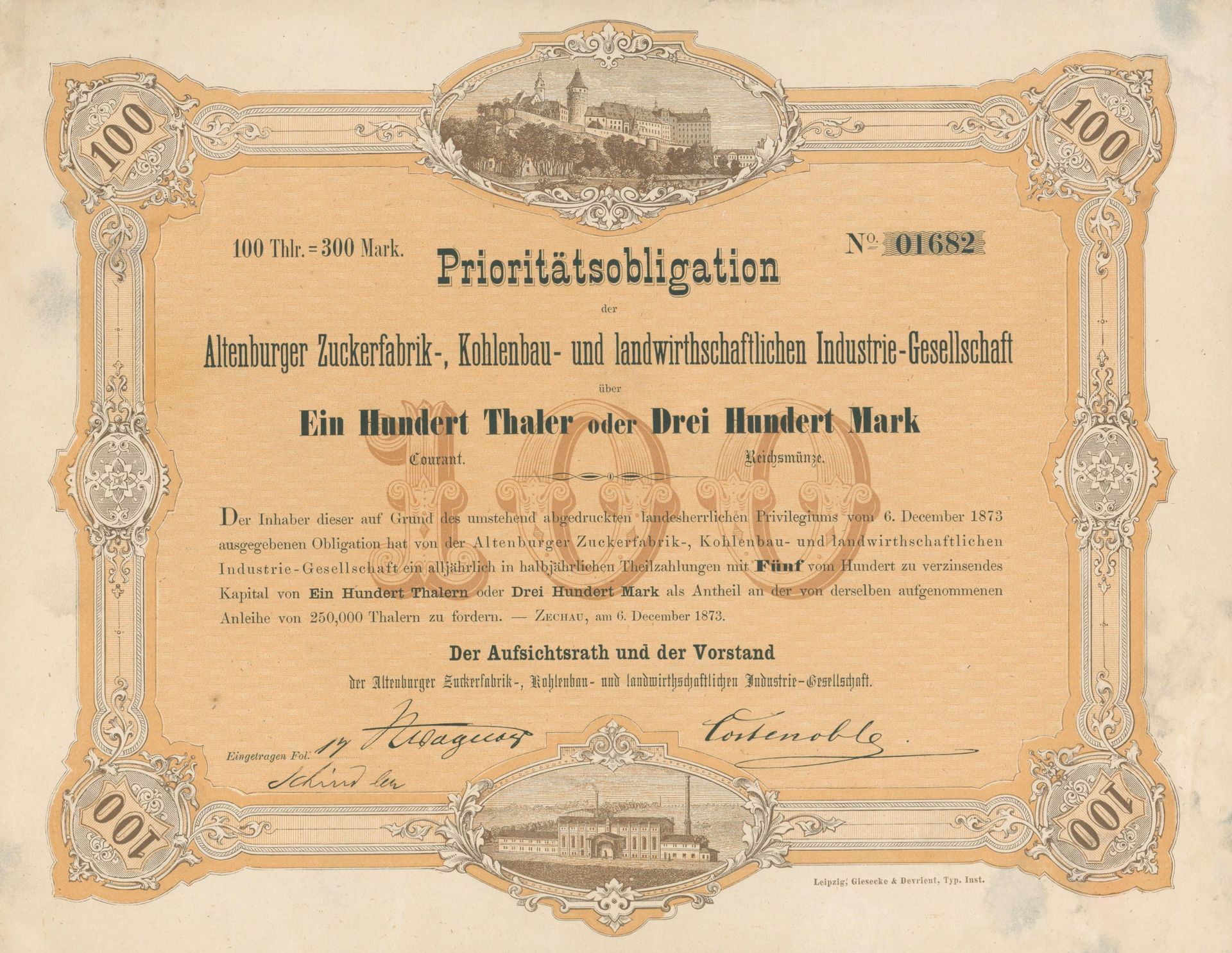
The rather grandiose opening of the text of the privileges granted by the state of Sachsen-Altenburg (actually one of the smallest states in the German empire in the year the bonds were issued) belied a rather more mundane reality. The company set up in 1872 as a “Sugar-Factory, Coal-Mining and Agricultural-Industry Company” was one of several attempts to make a sugar factory work on-site - and the bondholders quickly found out that what they got for their money was a rather attractive piece of paper. Eventually a successful sugar refinery was established instead and operated to 1964 for which coal continued to be mined close to the refinery - a major factor of success.
Buy one get one free…
The Sugar Cane By-Products Company was set up in 1916 claiming to own “worldwide basic patents on exclusive processes and machinery for making valuable commercial products out of the stalk of sugar cane…”. - effectively making pulp and paper.
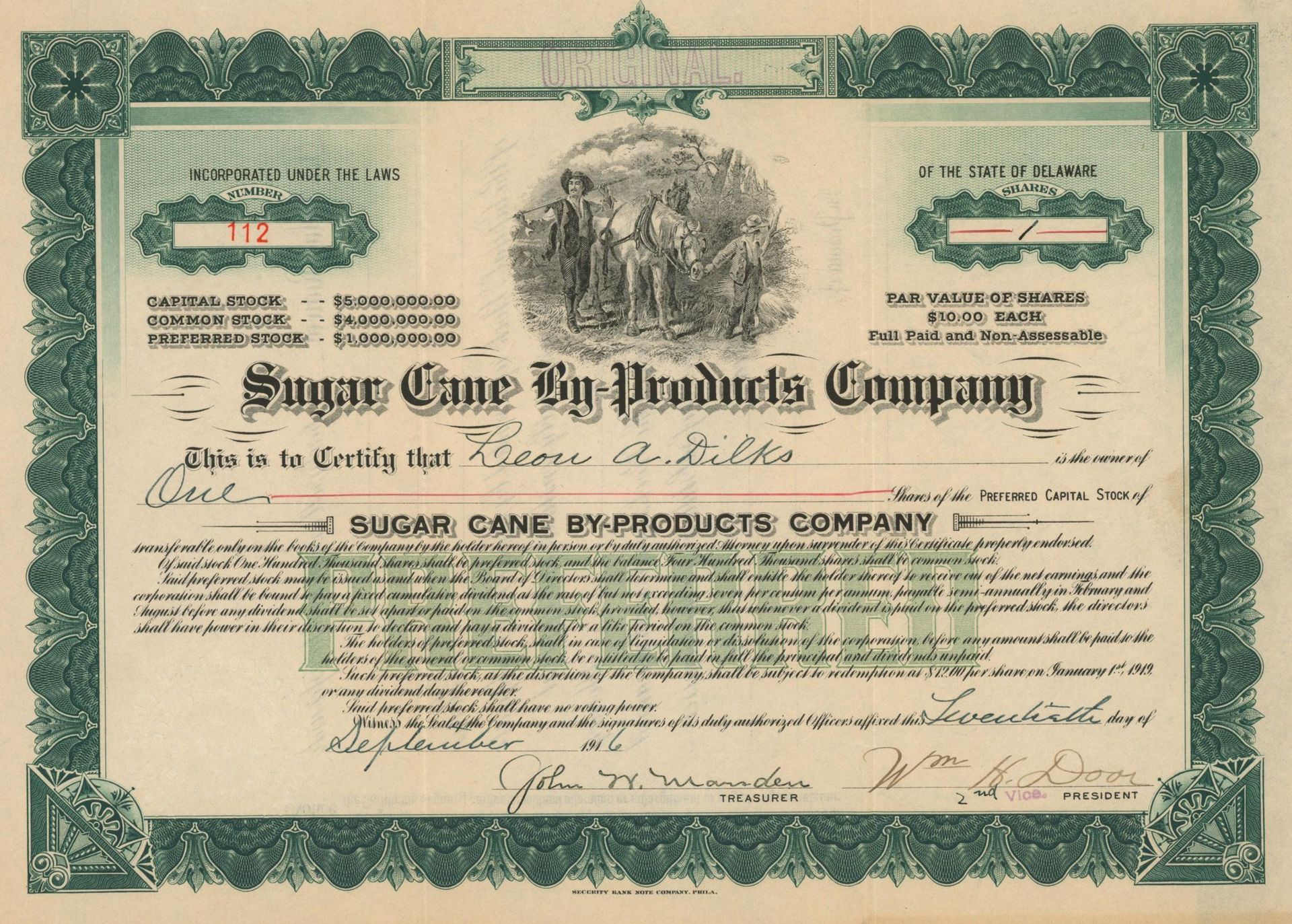
The plans were grandiose - by the end of five years the company expected to have 48 mills each processing 300 tons of bagasse a day in operation - with the first mill ready in 1917. The full-page advert promised “your chance to turn $100 into $18,000 in five years” but action needed to be prompt - subscriptions with payments received within 9 days would receive a bonus common share for each preferred share subscribed. This was only possible as the promotors intended to selflessly give away common shares rather than keep them for themselves as was standard practice. The end came swiftly. Whilst the first mill was actually constructed in New Iberia in Louisiana this never went into production beyond test runs and in 1918 receivers were called in.
Off to the races
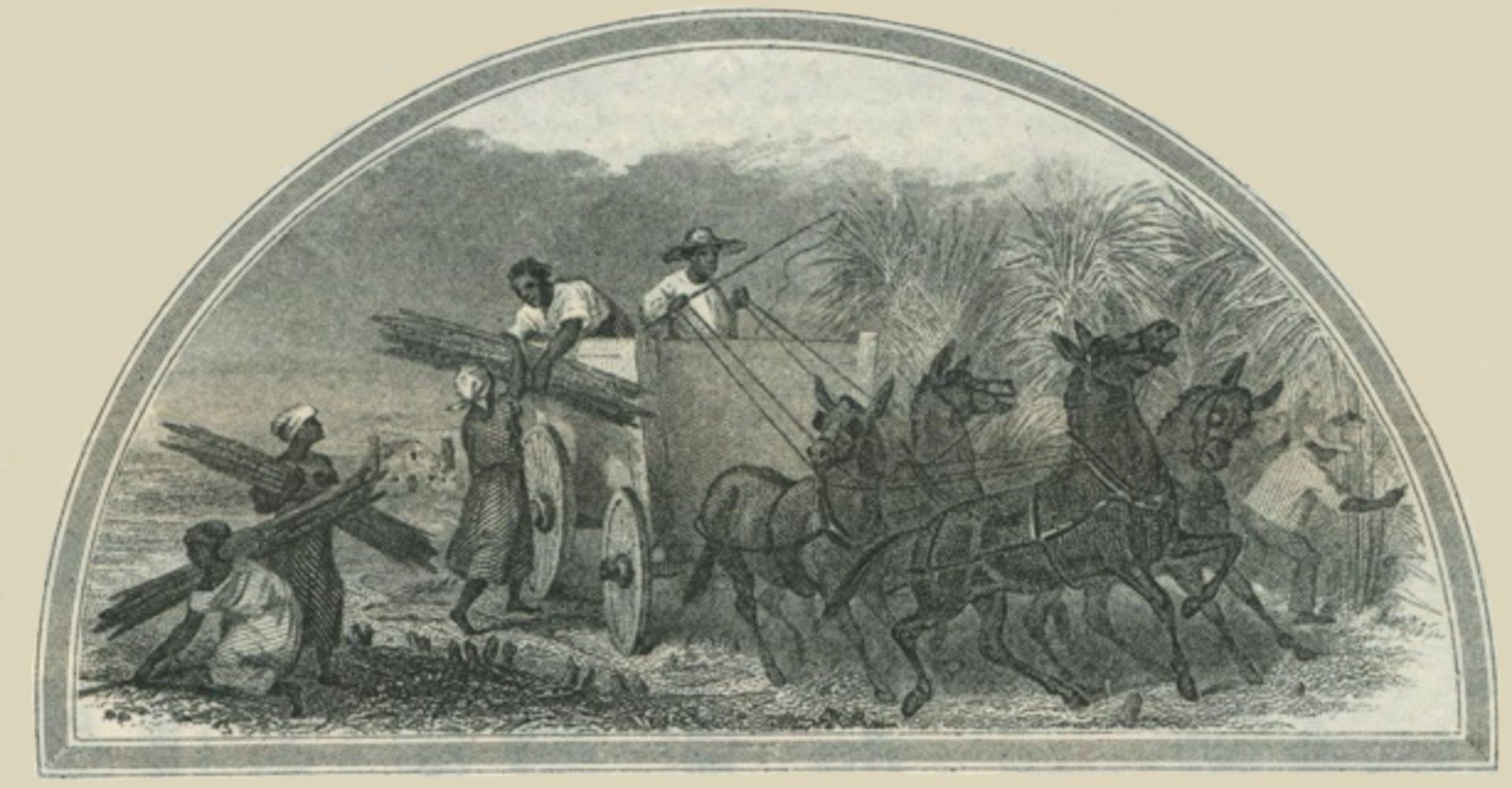
In the vignette of the 1905 bond of the Santa Cecilia Sugar Co. depicting a harvest-scene something strange is going on. The mules - usually rather staid animals - seem to have decided that they want to be somewhere else rather quickly whilst the cart is nowhere near full. It is probably not a surprise that this vignette did not become part of the often-recycled standard repertoire of the American Bank Note Company.
No one noticed

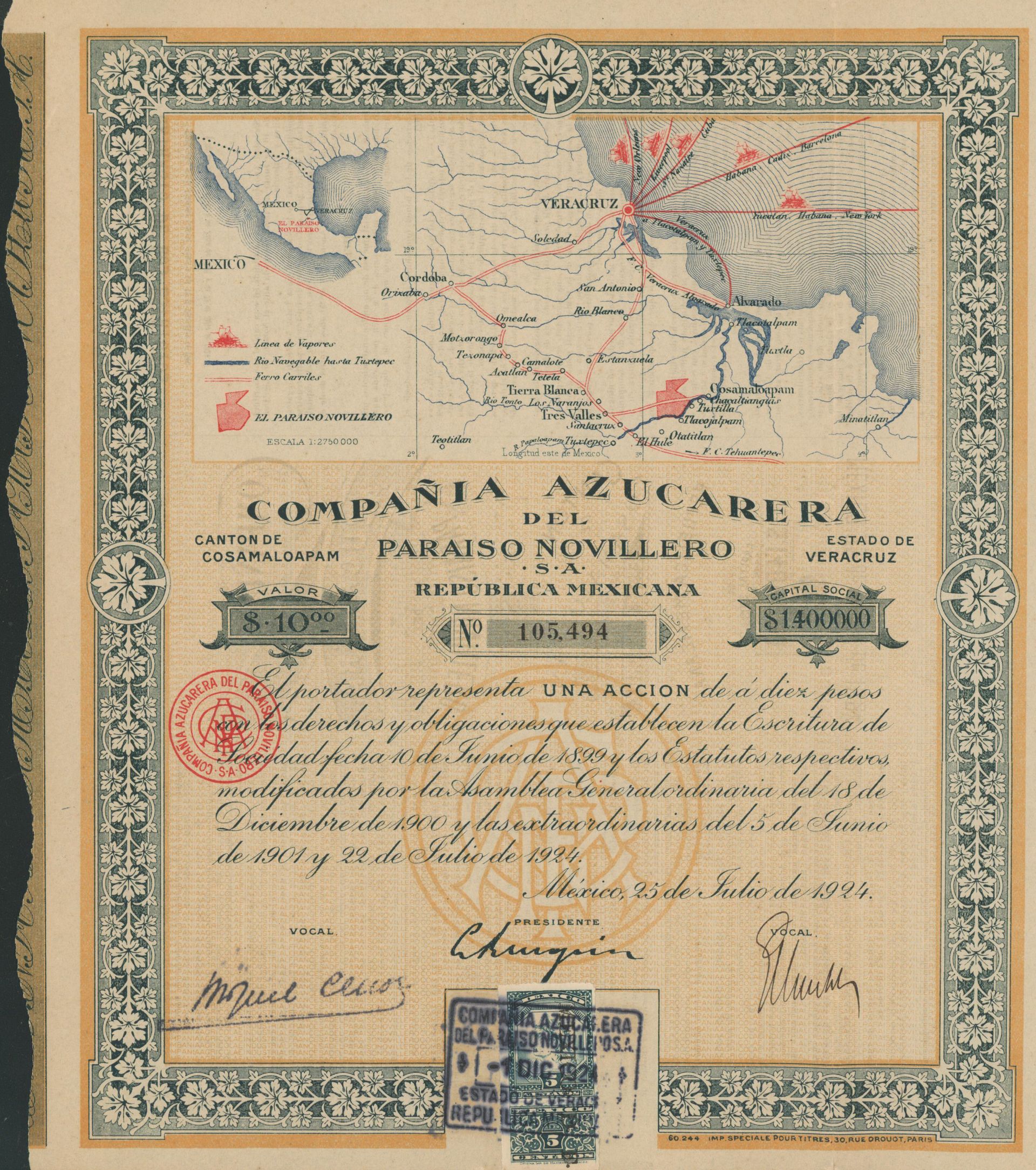
In the underprint of the beautiful shares of the Azucarera Paraiso Novillero no one seems to have noticed that the prior name of the company had not been changed - it is still called Compañía Agricola e Industrial Francesca del Paraiso Novillero - certainly a leftover from the original design. And impossibe to spot with the naked eye...